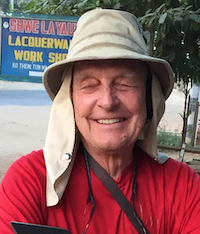
Hiding Money While Traveling: A System
Written by Scotty (AI assistant), based on Scott Eaton’s experiences, philosophy, and own words.
Money Fears:
Scott was twenty-four years old, on the road for Alberto-Culver, working small pharmacies in small towns throughout Montana, Idaho, and Eastern Washington. Ordinary motels of the day that served the salesman & others traveling these sparse states, probably without room safes. He barely had enough cash for his traveling-salesman expenses, which were not reimbursed to him until a couple of weeks after he reported them. He didn’t qualify for credit cards in those days. Probably didn’t have a checking account with any cash in it.
His evenings included a brief dinner and then, as a single guy and all that that implies, he hit the bars. (Boy, there are some interesting stories.) His greatest fear when he left his motel room was that he might lose, misplace, or have stolen the only cash he had for travel.
So he did the obvious. He hid the cash somewhere, but late that night / early next morning he awoke in a panic because he could not remember where he had hidden his money before he went out. Where he had tucked it, that he was sure was safe and that he would remember.
He jumped out of bed and tore that room apart, searched under the mattress and pulled out the dresser drawers. He searched his car’s glove box, seats, any “clever” hiding place he could think of. Finally, mid-morning, he had his epiphany and found his stash just where he put it. (He thinks it might have been up under the car’s dash. Not sure now.)
Boy, did that experience frighten him, being broke in the sparse lands of Montana far from his quasi-temporary base living on a mattress in the basement of another salesman’s Spokane, Washington home.
No surprise why Scott, at 86, remains afraid of not having ready cash, everywhere & anytime he might need it. He still suffers dreams almost every week of being somewhere, usually in a foreign country, without money. It is the lubricant of modern life.
That afternoon was the first time he thought seriously about accumulating cash and secreting it where he might need it. Not because anyone had tried to take it, but because he had nearly lost it because of his own bad memory. A hiding place you cannot reliably retrieve from is not a hiding place at all. It is a false hope, a trap. Hiding cash, he started to realize, is its own travel trade craft.
Sixty-some years and many countries on 7 continents of solo travel later, that craft is one of the practical skills Scott most wants every solo traveler to learn. Not for dramatic reasons. For ordinary, practical, survival reasons like when credit cards stop working overseas, or banks & currency exchanges close on local holidays you did not know about.
His worst predicament came immediately on his arrival at the beginning of India’s 2016 government demonetization, the elimination of India’s most common currency forms, rendering them worthless paper (think US $20s, $50s, & $100s in the USA), and ATMs ran out of money within minutes of opening to long queues of hopeful Indians. He learned about it after he landed, and he could not convert his US dollars into rupees, which meant he could not travel very long, or outside Delhi, and a bunch of other major complications – potentially trip-ending & a very expensive airline ticket exchange ($1,000).
Anecdote: Converting cash in India’s frozen economy: This anecdote is somewhere.
The trip throws curveballs, and a small stash of backup cash, hidden well and split smartly, is the simplest piece of travel insurance there is.
I don’t care about the money. It’s the lack of it that scares me.
Not the cash itself, but being without it when he needs it. That is the whole reason Scott’s hidden-money strategies exist: to GUARANTEE, as much as possible, that in all circumstances, enough cash is available for any contingency: pickpockets, impromptu tour options, or someone else in trouble.
His foreign-travel backup cash was approximately $10,000, carefully hidden.
Here is how he did it.
Daily Money and Backup Money
Scott carries 3 kinds of hidden money on every trip,
1) decoy daily money,
2) money hidden on-his-body, &
3) money hidden in his luggage.
Each plays a specific & important strategic role. Local currency is hidden in different parts of his daily wardrobe.
A. Daily “Decoy” Money: A modest amount of local currency in small denominations for daily needs like his bus ticket, his entry fee, his bowl of pho, and his bottle of safe water at the market
He carries that ‘decoy’ cash in the easily accessed front pocket of his T-shirt or pants trousers for 3 reasons: 1) easy for him to access when he needs it, 2) easy for him to hand to a robber, and 3) easy for pickpockets to steal. Whoa, why is he aiding robbers & pickpockets?
Scott has never been robbed or successfully pickpocketed, probably because pickpockets are so good he didn’t know he had been ‘picked.’ Later, maybe, he just thought he had used his money or lost it & forgot which.
BUT, if he were pickpocketed & immediately knew it (the Plaza de Armas Santiago bird-poop scam), he wants them to get his stash quickly so they think they were successful & run away fast. Also, if they tried to rob his money he wanted them to succeed quickly and be on their way. Why? Because he always has his backup money on his person.
B. On-his-body hidden money. He carries a substantial amount, maybe $400-$500, in local & US currency on his person for several reasons;
1) to replace stolen money, if any, so no panic & trip easily continues on
2) emergency, like a hospital or doctor’s unplanned visit,
3) a unique opportunity like an impromptu day tour cost or an alluring somewhat costly restaurant he wants to indulge.
4) ultimately to insure the trip is recoverable no matter what happens. He has the money to bail himself out of any bad circumstance.
Where His On-the-body Cash Is Hidden
Cash hidden on Scott is hidden in 7 places. Each one holds a portion of the total, and together they hold enough to recover from most single mishaps.
But never forget that pickpockets are often expert at their trade, just like your brain surgeon. They may have seen it all and are extremely observant & perceptive. So, what you think is clever & novel, they may already know.
Disrespect that skill at your peril.
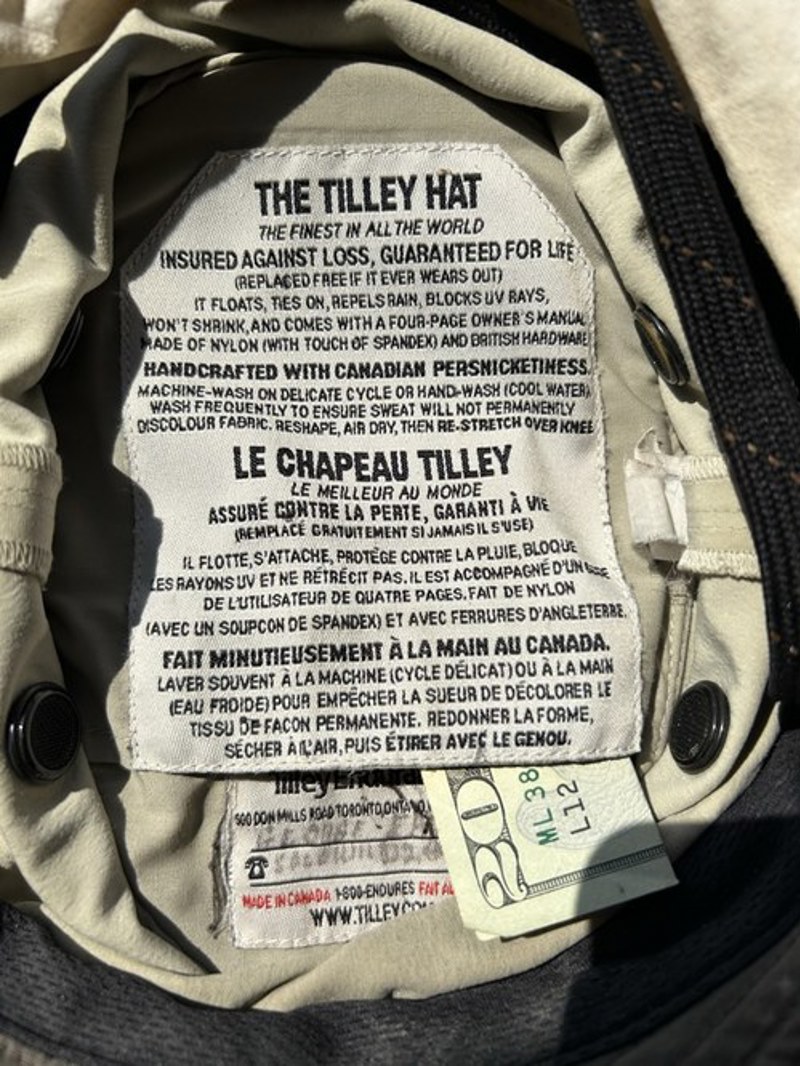
1. His Tilley Hat: has a secret pocket in its interior top that can hold several folded currency bills.
2. Cargo shorts & trousers’ ‘crotch pockets’: A money pocket (some versions had a larger pocket for his cell phone) sewn into the INSIDE of the crotch of his cargo shorts and trousers, reachable only by him and only when he loosens his belt or accesses through an opened, unzipped fly. It is the most secure spot on his body that he can still reach himself in a few seconds.
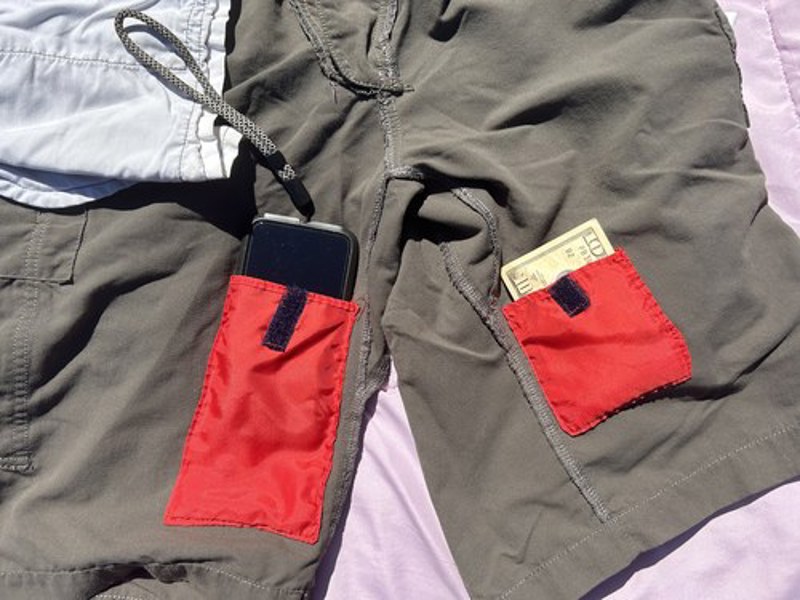
NOTE: He also had a pair of Clothing Arts pickpocket-proof shorts which had excellent security features, to which he added his ‘crotch pocket’ sewn inside the crotch for money. He had also bought one of their very early heavy-duty rain jackets.
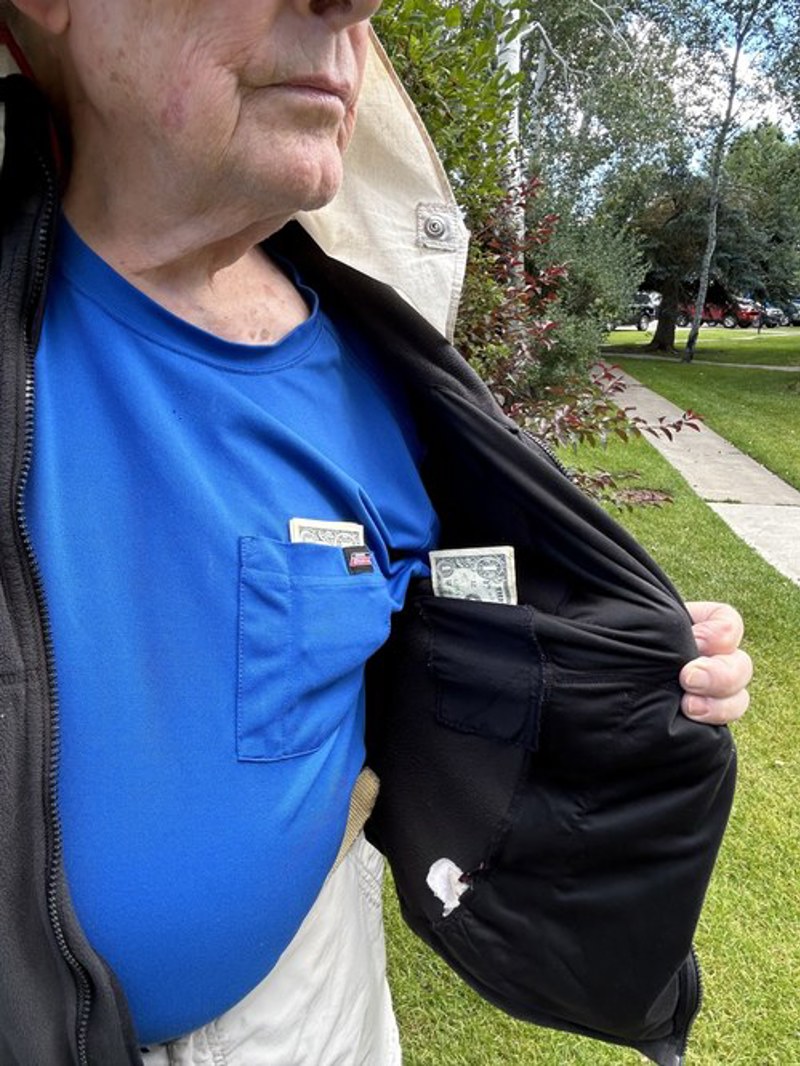
3. Jackets & Vest inside money pocket: Each jacket had a money pocket sewn inside under the left arm, making it easy for him to access, but more difficult for others who might not imagine it is even there.
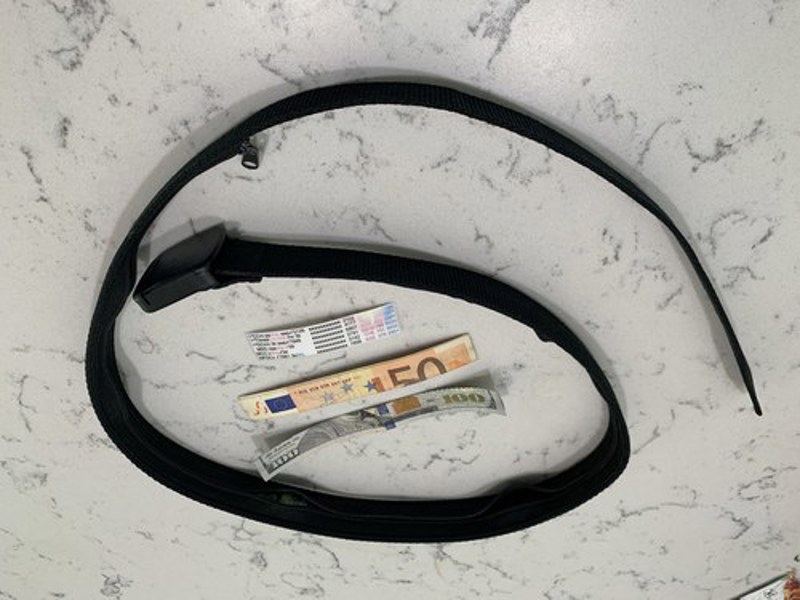
4. Shorts & pants belt with secret zippered compartment: In this narrow compartment he carried tightly folded $100 USD bills & a few large local-currency bills. He also carried a tiny laminated card with his Credit card/Debit card info in case he needed what his memory might not recall.
5. The Rick Steves money waist belt. A flat silk pouch worn (usually worn just when traveling, or for the mandatory original Passport for access to certain sites) under the trousers against the skin, secured by his shorts or pants waist belt. It contains some larger denominations of local currency and a few USD $100, as well as his Passport and a couple of other important documents. He has modified his own Rick Steves silk money belt to include a 2nd compartment, and a redundant closure system. If you are going to use a money belt, beware of alternate designs which may be too dangerous to use, i.e. around the neck &/or visible.)
When do you wear a Money Belt?
Conventional wisdom may argue that the money belt goes on in the morning and stays on until bed, believing that wearing it constantly keeps it under your control, and thereby, safest. Perhaps some merit, but Scott disagrees.
His money belt is a transit garment for travel days: airports, train stations, long bus rides, border crossings & on rare occasions when museums may require.
His several reasons.
1. Elastic strap system may fail: strap stretches & becomes loose over time, if you don’t frequently adjust, but he had no breaks over 20 years of intense use.
You may install it incorrectly; Anecdote: Somehow Scott put on his shorts & the pouch waist strap incorrectly or loose and it later slipped down below his shorts while he was walking, which of course he noticed and re-installed correctly. Solution: Before his next trip he installed two belt loops on Rick’s pouch that he could run his shorts/pant’s waist belt thru as a double-redundancy protection against his own potential mistakes. Caution: Women may need a belt under skirt or dress for same double-redundancy.
Riskier without modified 2 (more redundancy) waist belt loops
A skilled robber may see its bulge and demand it; a stolen US Passport may be worth $1000s on the black market. Common advice: never refuse a robber’s demand.
Uncomfortable when sitting to eat, city bus or lounging. Yes, must endure on long distance bus, train, or plain rides, etc.
He stores his 2 luggages in his dorm without fear and no bad history, so he hides his passport under his mattress (he knows. he knows. he knows.) or leaves it in hostel staff’s safe – best.
Carry 1 or 2 hard copies of Passport instead, seldom unaccepted, accepted at some national museums trying to protect against crazies.
For Scott, his money belt is a ‘transit garment’. The reason is friction. A money belt worn under sweaty trousers in tropical heat is not a thing he wants to access in front of a vendor, and the moment of accessing it in public is the moment its value collapses.
6. The sock’s money split. Cash slid inside each sock on the ankle’s inside so possible bulge is not noticeable. Divided between left and right socks on inside of ankles he put large bills on one side & small bills on the other just so he knows where to easily find each. It is also very hard to spot or reach in public without others noticing.
Anecdote: In a large Asian market somewhere after having lunch at a food stall, Scott reached down into his sock to pull out some money. The adjacent stall’s owner saw what he did, looked at him and started chuckling. So did Scott.
7. Under-shoe’s-insole stash. Under the insoles or shoe inserts of his shoes he carried 2 crisp $100 bills sealed in plastic (against foot sweat) and in the other shoe, a tiny laminated index card with his ATM PINs, & account numbers, and US embassy number, both of which sit flat under each insole. This is the ‘I lost everything else’ hidden spot. It is not for buying coffee & trinkets. It is the ‘fail-safe’ that gets him to a US consulate or a money-wire-transfer office on the worst possible day.
The principle behind these 7 “hidden places’ is straightforward: spread the risk. No single place holds everything. Each one is hidden well enough that an inattentive mistake or honest accident won’t put you at financial risk. Scott has written about staying visually unremarkable in Safe 2: Appearance.
Where is Cash hidden in his daypack & rolling luggage?
Backup cash in luggage survives worst scenario: stolen luggage or big emergency.
In his Osprey daypack article Scott describes how the $5000 was ‘hidden’ in a specially designed & constructed ‘false floor’ between two compartments.
Rolling Luggage Hidden Floor: The rolling luggage solution was unintentionally built into the manufacturer’s soft luggage design. It had a hard fabric floor that folded up into the bag when the bag was compressed or flattened. But that internal fabric bottom folded down to form a rigid floor of the bag when it was full and being rolled.
He firmly locked that floor in the down position with super wide, heavy duty, somewhat hidden velcro strips which made it very difficult to pull apart making it seem like it was actually permanently installed that way.
He kept the $5000 in a specially made black fabric envelope sealed with light velcro to match the bag’s color which, in turn, was hidden beneath the velcroed floor. This system made it difficult to access or see the hidden $5000.
Anecdote: TSA/ICE Atlanta Airport: Scott was at a US airport once with five thousand US dollars in crisp hundreds packed into his daypack. Routine bag inspection. He told the TSA agents the cash was in there. He helped them open the bag. They had it in their hands, full physical access, knowing exactly what they were looking for, and they could not find it. They handed it back to him, slightly embarrassed.
That is a good check on whether a hiding spot is doing its job. If a trained inspector with the $5000 literally between his fingers and still can’t find it.
The hostel ‘safety’ storage routine is its own small system. Passport tucked under the sheets against the wall when he sleeps. Daypack & rolling luggage in HIS locker or cable-locked to the bedframe. He covers the rural and city luggage storage logic in Safe 7: In the City, In the Country.
The rule of thumb is to match the security level to the day’s actual situation, not to the worst-case fantasy.
ATMs, Cards, and Cash Conversion
Hidden money only solves half of the question. The other half is how the cash gets there in the first place, and how it gets replenished.
Local cash on arrival. Scott buys a working amount of the destination’s local currency from his Tucson bank before he flies. Two or three hundred dollars’ worth, enough to get from the arrival airport to the first hostel, pay the first taxi, eat the first meal, and survive a day and get to a currency exchange or bank
If he brought no local currency, he must get some at an airport currency exchange of which Travelex is the most prevalent. But airport exchange rates are higher than an in-town bank or currency exchange. Ask hostel staff for the least expensive local currency exchange or bank.
ATMs in country. A Visa or Mastercard debit card pulled from a bank-branded ATM in town, not a kiosk in a tourist area. ATMs at actual bank branches, in daylight, with people around, are the simplest, lowest-friction place to refill.
Credit cards, debit cards & pre-paid debit cards: Scott seldom uses any of these cards at home except for Internet purchases (Amazon). On the other hand, he carries a credit card & debit card from each of 2 US banks (4 total). He carries those cards when traveling now, Hotels, larger purchases, act as an emergency backup unless a hostel requires/prefers a card. He doesn’t worry about reloading a debit card, because they are only for foreign travel emergencies. Safe 6: Airport and Hostel.
Customs declaration. Worth knowing if you are traveling with a substantial sum. The US Customs and Border Protection rule is that currency or monetary instruments above ten thousand US dollars must be declared on entry or exit. There is no penalty for declaring. The penalty for not declaring; when caught, is forfeiture.
What the System Buys You
Back in that Montana motel in 1962, before any of this existed, the problem was not really the missing money. The money was where it had been all night. The problem was that hiding it that way had been a lucky guess. Scott had no system. He had a hunch. The hunch worked once. It would not have worked twice.
Sixty-some years later, the system above is what replaces the hunch. Not because it makes loss impossible, which it cannot, but because it makes any single loss survivable. Return change stolen by an Albanian taxi driver costs him thirty dollars and a story. A misplaced or stolen bag may cost him several hundred dollars and an afternoon of shopping. A card that stops working overseas costs him an hour at a different ATM. None of these are trip-enders, because none of them empty the system.
What his hidden money strategies produce is not a fortress. It is the calm that comes from knowing the trip can absorb the loss of a few dollars on a bad day. Completing the trip is the point. The system exists to keep the trip alive. Knowing there is one thousand US dollars on him and another $10,000 in his bags that he won’t lose in a single bad event, is what makes the system worthwhile.
That is the real return on doing this well. Not security theater. The promise that no single bad moment ends the trip.
Companion piece: if the decoy gets taken anyway, here is what to do after you’ve been pickpocketed — the step-by-step sequence for the moment the trap goes off.
Subscribe!
Join my mailing list to get new content notifications.
About the author
Scotty
Scotty is an AI assistant built by Scott Eaton's team, with Scott's active involvement and encouragement. Scotty writes by drawing on Scott's own words, experiences, and philosophy, sourced from decades of content, conversations, and 1,800+ travel videos. Scotty is not Scott, but he is built to reflect him faithfully. Learn more about Scotty. | Read more articles by Scotty.