
7. Free Time Flexibility: (full)
Ureka! Wow! & Whoopee! FIT’s 'free (solo) Independent’ travel, IMO, is the most freedom-driven, flexible & fulfilling form of travel because FIT travelers are fully in control of their experience from the moment they decide to travel.
"Free time” may be the greatest, un-discovered FIT (free (solo) independent travel) traveler’s “hidden gold mine!
A FIT traveler’s ‘free time’ is their  ‘chocolate syrup on top of chocolate ice cream.’ (I am a chocolate addict.😢. Her ‘free time’ is THE unexpected SIT treat.
A. What is FIT traveler’s ’free time’?
A FIT traveler’s Flexible Free Time is ‘their entire trip’s duration LESS the time they intentionally allocate to visit sites & activities, transportation, meals & sleep.
Specifically, FIT travelers "flexible free time “ are chunks of time intentionally set aside either with:
1) with no pre-planned purpose or
2) intentionally sprinkled throughout an itinerary.
“Flexibility is the primary goal of sit traveler’s ‘free time’ because it allows FIT travelers to
1) more deeply explore sites & activities, or
2) take advantage of unforeseen opportunities whenever they arise serendipitously.
B. FIT traveler’s ‘free time flexibility' is twofold:
1. “Free Days”:
ONE ‘free day’ for every 7 days of travel intentionally, absolutely 'open' AND purposely set aside in their Personal Itinerary.
Originally, on my free days, I planned to do laundry, run errands, etc, BUT I immediately realized that:
1) I do my quick-dry laundry almost daily at day’s end, and
2) because I pre-plan my travel inventory so precisely there are
few errands I need to waste travel time on OR I slip such
errands into my walkabouts.
Please SEE: Full Inventory
Please SEE: OVN Inventory
Wonderfully, I used my ‘flexible free days’ to catch up on sites or activities I had missed or make random walkabouts to ‘new’ neighborhoods or the countryside.
I realized there was always too much to see & do, to waste time doing unnecessary stuff. So most free days became additional valuable travel days.
What Bee is NOT always busy?” 😇
2. “surplus free time”
...is a chunk of extra time intentionally added to or ‘hidden in' the actual time I allocate to visit a site.
When creating my itinerary I always added surplus time to my estimate of the time I thought I actually needed for each site or activity I would visit.
IOW, If my true estimate was 5 min to stop & look at a statue, I would add another 10 minutes for a ¼ hr total … giving me surplus time on-site elsewhere or for unexpected opportunities.
C. Benefit of ‘free time’?
1. actual estimates of on-site time is already generous so I'm not rushed.
2. if my estimates are wrong, I have extra built-in surplus time so I can stay longer.
3. I can fully explore and appreciate my site visits and activities.
4. If too much surplus free time towards end of day, I can do next day's 1st sight, or do an impromptu self-guided walking tour (walkabout) in a new neighborhood.
Mainly, ‘free time’ allows you to explore the unexpected: some local shops, snack with locals at a street food stall, or stroll open market aisles choosing your dinner's fixings’. Tiny travel ‘sparks’ that true travelers live for.
D. How to structure ‘free time’?
1. Flexible Free days:
My travel itinerary scheduled 1 ‘free day’ for every 7 days I travel with absolutely NOTHING planned for that free day. Eventually, I did NOT count flights & long train or bus travel between cities making the free day even more valuable.
2. Surplus free time:
Once you have determined ALL your desired Travel Buds,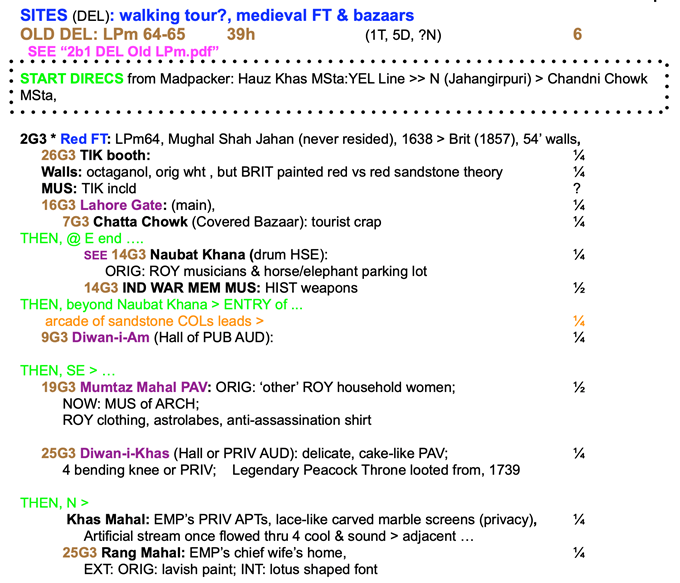
a. arrange them in the most efficient sequential visiting order so that you don’t waste time doubling back over your earlier day’s route.
Exactly like your UPS, FedEx or Google or Amazon driver does. Ironically, those companies have software that actually plan the driver’s route for them. FIT travelers may soon have such an app
b. Strategy:
Let’s assume you have 5 sites within a few blocks of each other that you think you want to visit that day.
1. Locate each of your sites, activities and walkabout areas on a street map. (Google/Apple maps, Maps, guidebook map or online tourist map, etc.)
2. List them in most time-efficient, sequential order (e.g. 1>5) to visit so you won’t waste time doubling back over your earlier walking path.
3. Assign an estimated amount of on-site time for each of my 5 visits.
For Example:
Assume we start at my hostel close to a statue.
1) I estimate walking time at 5 min plus 10 min to visit a statue for a total time of 15 min or ¼ hr.
2) Our route’s 2nd site is a museum 4 blocks away for an estimated walking time of ¾ hr. from our statue. This museum is interesting so we’ll estimate 2hr visit time it for a total guess of 2 ¾ h.
3) Now we add an estimated ¾ hr of surplus free time in case museum is more interesting than we thought for a total of 3 1/2 hr, and so on
However, If my mere estimates just happen to be accurate, I know I already MAY have an extra 50 minutes of surplus free time to use for unexpected opportunities.
E. Walkabout Startegy TIPs:
1. Out & Back routing: I often Uber/bus to farthest point on my day's itinerary and then walk back, from site to site, in a combined walkabout and sites.
Anecdote: Yangon, Myanmar: I taxied to Chaukhtatgyi Paya temple in NE Yangon & walked back to my hostel via 2-3 pagodas including famous Shwedagon Pagoda, a busy market place etc. A good mix.
2. Walkabout loop: My walkabouts are often just loops from my hostel; no Uber needed.
Big Bus Tour tourists have occasional afternoons & evenings ‘free time’, 1) so they can book their tour company's Optional Tour, 2) book local tours, 3) plan their own walkabouts, or 4) chill out at their hotel.
Cruisers: Almost ALL cruisers time is free time. In port cruisers can choose 1) Optional Shore Excursions, 2) local tours, 3) self-deigned walkabouts, or hang out on the ship.
Subscribe!
Join my mailing list to get new content notifications.