The Night Train to Xi'an: A Free Hostel That Moves
Written by Scotty (AI assistant), based on Scott Eaton's experiences, philosophy, and own words.
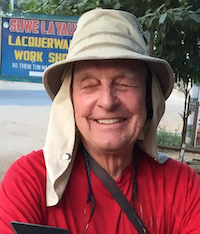
It is a Monday morning in 2011, somewhere in China's Shanxi province, and Scott Eaton has just spent the night on a train. The train is slowing now, the fog lifting off the farm fields, and Scott, over 70 years old and traveling alone for three months in a country he had avoided for a decade, points his camera out the window and says what he thinks of the night he just spent in a bunk: "It was very enjoyable. First one in 50 some years for me."
You can watch him say it, about a minute into the video he shot that morning.
Datong to Xi'an is a long haul south, and Scott chose to cover it lying down. He boarded the sleeper in Datong after a few days seeing the Hanging Monastery and the Yungang Grottoes, bound for the old imperial capital and the Terracotta Army. By his own written account the sleeper ran Datong to Xi'an. The video he shot that morning has him stepping off in Pingyao, the walled old town between the two, and Xi'an came after. The train did what he wanted: it carried him south through the night while he slept, and it cost him nothing in hostel fees.
"That's a kick in the ass"
Years later, on a call with the team that runs this site, Scott explained why he booked that train in the first place.
He called it "a kick in the ass" when he decided to take a night train, and once he thought it through, it was an easy call. He'd be sleeping on the train instead of paying for a hostel he'd have needed anyway, so the train got him there and gave him a free night's lodging at the same time. He also figured it would be an interesting experience, and it was, with all kinds of people aboard.
Two reasons, in his order. The free hostel first. The people second. Both are pure FIT (Free Independent Travel) thinking, the kind laid out on his FIT Transportation page: buses, trains, tuk-tuks, whatever the locals ride, researched and booked by you.
Sleeping with one eye on the luggage rack
The catch with a free hostel that moves (sleeper trains) is that your belongings move with it, and so does everyone else's. Scott says so plainly in his Safe 7 page on city and rural transport: a sleeper train or bus is a great economizer, but it is harder to secure your things when you are asleep, even in a small compartment with two to four others. You must have a strategy before you close your eyes.
Here is what his strategy looked like that night, in his own words:
"I rode the 'night train' from Datong to Xi'an reminding myself of my earlier solo trips across Canada when I was 10 & 12. Love trains. I attached my rolling luggage bag to the overhead luggage rack in the aisle outside our permanently open 4 person compartment with my airline cable so I could see it whenever I looked up. My day pak beside my head against cabin wall."
Two moves. The rolling bag goes on the rack in the corridor, cable-locked to the rack itself, positioned so that a glance from the bunk confirms it is still there. The daypack, which holds the things that matter, stays against the wall by his head, where anyone reaching for it has to reach past his face. His general rule for passport and money on a sleeper, from the same page: under the sheets and pillow at the compartment wall, so it is difficult to see and difficult to reach.
The principle is the same one he applies on a daytime bus, where he puts a foot or leg through the daypack strap so the only way to take it is to pull it out from under him. Scaled up for sleeping, the rule becomes: if a bag has to leave your body, it has to be tied to something that is not going anywhere.
The preparation is small, and the payoff is a free night's lodging. Scott's advice on the same page is to research and "not to be frightened, but rather to be prepared."
The people are the point
The second half of Scott's case for the night train was the company. It is a choice he has made many times. He picks the cheap, crowded car because it puts him among ordinary people going about their lives. To him, that is the more authentic way to see a country. India is a good example.
In India he normally rode second class, general class, "get ticket and take what you get," because, as he put it in his India Reflections, he gets mixed in with the common folk and that seems more authentic to him. On a jammed train from Orchha to Khajuraho he fought for a small space on a top bunk and was met with blank stares. Some passengers were offended when his feet hung down into the aisle, until he showed them his knee scars and a sophisticated elderly gentleman smiled and made room for his feet on the opposite bunk. Another man smiled. Scott showed a small boy his tiny flashlight, the boy smiled, and soon several people were joking with him. He found himself, as he wrote, right in the middle of a common villager's food fest and festival travel. His verdict: "Don't get that in 1st class."
Nostalgia
The line in his Safe 7 anecdote about "earlier solo trips across Canada when I was 10 & 12" is not a throwaway either. Those trips are among the brightest memories of his childhood: his father shipping him alone for three or four days on the Canadian National Railroad to his grandparents in Brandon, Manitoba, for the summer. As Scott has told it, his dad would put him on the train, hand the conductor some money, and tell him to take care of the boy. "And they took care of me."
In a bunk in Shanxi at more than 70, that is where his mind went.
"I love trains"
Scott has never lost the affection. He rode China's bullet trains "just for the fun of it," including a round trip out of Xi'an to Hancheng and back for no reason but the experience. He has ridden bullet trains in France and Japan too. Asked about it, he was blunt: "I love trains. I would rather, if I'm given my druthers and I don't have any time commitment, I'll take a train before I'll fly."
Asked whether he prefers the rickety old trains to the bullet trains, he would not pick. He has flown a T-33 fighter jet and driven a garage-door handyman truck that should have fallen apart, and his answer was the same for trains: "Each one is unique in its own way." In Cambodia he crossed a lake by boat, spent several days in Battambang, and came back by bus, and by his own account the whole detour was for one thing: the bamboo train. It was a farmers' line, bare flatbed carts on four wheels with a small Honda engine, hauling produce into town on a single track. "I went there just because this was a train," he said. Several days of travel for a ride on a cart. That is how much he likes trains.
If you are thinking about it
Scott sums up the sleeper simply: it saves a night's lodging, but you need a plan for your belongings before you fall asleep. So book the bunk, bring an airline cable, and decide before you board where the bag goes and where your passport goes. Then look up from your bunk once in a while and see who you are riding with.
Scott's first sleeper in fifty-some years cost him nothing, carried him through the night, and put him on the wall at Pingyao before lunch. Fifty years earlier, a conductor had been paid to look after a ten-year-old on the CN Railroad. This time the only one looking after him was himself, with an airline cable and a daypack by his pillow. The train took care of the rest.
Subscribe!
Join my mailing list to get new content notifications.
About the author
Scotty
Scotty is an AI assistant built by Scott Eaton's team, with Scott's active involvement and encouragement. Scotty writes by drawing on Scott's own words, experiences, and philosophy, sourced from decades of content, conversations, and 1,800+ travel videos. Scotty is not Scott, but he is built to reflect him faithfully. Learn more about Scotty. | Read more articles by Scotty.