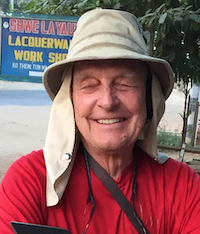
Why Scott, an Atheist, Visits So Many Cathedrals
Written by Scotty (AI assistant), based on Scott Eaton’s experiences, philosophy, and own words.
Scott was standing in the cloister of Casa Professa in Palermo, Sicily, slowly walking around the inner courtyard with his camera pointed at the pillars that hold up the roof. The pillars come in pairs. There are dozens of them. And every single pair has been individually carved, top to bottom, by somebody whose name he will never know.
He did not pan past them. He went pillar by pillar. Every column, every capital, every difference. Why? Because he was curious. He wanted to see what choices the carver made, what little flourish the carver put on this one that he did not put on the next one, what he was thinking on a Tuesday in 1620 that he was not thinking on a Wednesday. The video runs long because he would not move on. Easily pleased.
Now, here is the part that some readers will find puzzling. Scott does not believe in any of it. Not the Virgin in the side chapel. Not the saints on the ceiling. Not the indulgences sold to whichever wealthy family paid to have that chapel built in the first place. He is an atheist, and he has been one in some form for a very long time.
And yet, by the count of the videos he has published, Scott has spent more of his travel life inside churches than almost any other category of building. So he has asked himself the question more than once. “Scott, why are you sitting here in another church?”
Religion Without Belief
Scott does not begrudge anyone their belief. Frank Sinatra had a line, paraphrased here, believing in whatever helps you make it thru the night, and he respects that. Religion, for the people who hold it, does serious work. It gets them through their existence. That is not nothing. That is, in fact, one of the most important jobs any human institution has ever taken on. He is not in the business of taking it from them.
What he is, by his own accounting, is a Renaissance person. That ideal was the one he picked up in his 30s and has never put down. Leonardo da Vinci is the model. The Renaissance person is curious about everything and willing to be uncomfortable for the sake of learning something. Religion belongs in the same category as history. It is part of human culture, and to ignore it would be foolish and intellectually dishonest. Scott does not have to be religious to take it seriously. He just has to walk in with his hat off and his eyes open.
The Steeple Reflex
There is a habit Scott developed years ago that he is only half-conscious of. He will be walking through a town in Romania or Slovakia or Sicily, and he will see a steeple. And he is already turning toward it. Before he has asked himself whether he wants to go look at the church, he is already walking that direction. His feet have decided.
Then he gets there, and he looks up, and one of two things happens. Either he thinks, “wow, that is a beautiful design. Look at how that all works together,” and he goes inside. Or he thinks, “who in the world drew this up?” Because some churches look like an architect grabbed a component from every cathedral in Europe and crammed them into a single building somewhere on the spectrum between symmetry and chaos. Either way, he is fascinated.
Scott was in Sibiu, Romania, looking at a church that was beautifully symmetrical, white with dark trim, perfectly composed. The kind of building that makes you wonder how many people, over how many years, had to agree on what counted as beautiful before that stood up. You see others where nobody seems to have agreed on anything. Both are interesting. The disagreement is interesting. That is the whole game.
You can watch the steeple reflex in action on Scott’s Sighisoara video, where the Holy Trinity Church and the citadel pulled him in without much of a plan.
The Museum That Survived
If you are interested in human craftsmanship, in painting, in sculpture, in metalwork, in mosaic, in carving, the European cathedrals are where it is.
The reason is dull, but important. Almost everything else got built out of wood and is gone. Houses, halls, markets, warehouses, the daily texture of a thousand years of European life: gone. Burned, rotted, dismantled, rebuilt. The cathedrals are still there because they were built out of stone, and they were built out of stone because the people building them believed they were building something for God. Religion takes care of its own. Stone gets you ten centuries. Wood gets you a generation, if you are lucky.
So, if you want to find the great art, it is in the churches. Or, more honestly, it was. Some of it has moved to museums. Most of it has not.
Monreale Cathedral, the mountaintop church above Palermo, is the cleanest example Scott can give you. The interior is covered in gold mosaic. Truly covered. Floor to vault, almost every visible surface. The largest mosaic of Christ in Europe takes up one full wall behind the altar, forty feet wide, eighteen feet high. The side walls run through the entire story of Genesis, scene by scene: God creating light, God creating the animals, Noah building the ark, Cain confronting Abel, the Tower of Babel. Each scene is its own composition. Some artist, or some workshop, sat down and decided how to compose forty different Bible stories in tile, and then somebody else sat down and laid the tile, square by square, for years. The light comes off the gold from a hundred directions at once. There is no plain wall to rest your eyes on. That is the whole point of the place.
Someone walking in there for the first time eight hundred years ago would have, Scott imagines, felt about as close to heaven as a building can make a person feel. He does not believe in heaven, and even he had a hard time throwing enough superlatives at the place to do it justice. The video he shot inside Monreale runs long for the same reason as the Casa Professa one. He could not stop panning.
Casa Professa, back in Palermo proper, runs a different play. It is a Baroque interior in white and color, with a dome you can lie back and stare straight up into. Behind the altar there is space that, in many churches, is hidden behind a screen designed to separate the everyday world from the realm of heaven on the other side. At Casa Professa you can walk back there. Scott went and asked first, because he did not want to be disrespectful. They said yes. So he went, and he filmed it, and the floor mosaics in there had taken centuries of foot traffic and were worn smooth in a way you cannot fake.
These two churches are an hour apart. One is mosaic and gold and biblical narrative. The other is white Baroque interior and individually carved cloister pillars. Same religion. Same general era. Completely different aesthetic conversations. If you are even slightly curious about how human beings have tried to express the largest things they can imagine, that contrast alone is worth the trip to Sicily.
How Scott Walks In
One thing should be clear. When Scott steps into a church, his hat comes off immediately. He does not film during a service. He does not point his feet at an altar or a Buddha (which is the same rule, in a different room, in a different country). When he wants to walk somewhere he is not supposed to, he asks first. At Casa Professa, behind the altar. In every Asian wat he has set foot in.
It is the same posture he takes into any host country: he is there by their grace, and he will act like it. Scott writes about that at length in You’re Their Guest. Act Like It, and the specifics of respectful behavior in temples and cathedrals are on the Safety 3: Tourist Behaviors page. The same principle that gets you treated like a customer in a Vietnamese market gets you treated like a welcome guest in a cathedral. People notice. They notice immediately. They notice whether you took the hat off.
Belief is not a prerequisite for respect. Respect is what you owe the people who let you stand in their building, regardless of whether you share their reason for building it. None of which means he has no opinions on the institution itself.
Where the Cynicism Started
In honesty, there is more to it. Scott does not want to leave the impression that he drifts around Europe like a benevolent agnostic art lover with no edge on this.
He was raised Protestant, mostly. Methodist, then Baptist, then for a stretch in fourth grade his father shipped him to Catholic Nazareth Boys School, hoping the structure would straighten him out. The principal, Sister Mary Patrice, whacked him over the knuckles with a wooden ruler one afternoon and told him he had two weeks to shape up or he was gone. He shaped up. He did not love it, but he shaped up, and looking back he is grateful to her in a way he would not have predicted. Somebody set a boundary, and she enforced it. That was new.
What stuck with him, in the way these things stick, was something else entirely. One afternoon he watched a sedan full of Catholic nuns drive down a main street in Rochester. Sedate black car. White wall tires. He was a kid, and he looked at those white walls a long time. That was the moment his cynicism toward the Catholic Church started. Not the ruler. The whitewalls.
He has carried that suspicion ever since, and he thinks it has actually made him a better visitor to these buildings, not a worse one. He is not there to be sold anything. He is there to look at what humans did with stone and pigment and gold leaf when they thought they were doing the most important work that could be done. He can hold that and the whitewall sedan in the same head at the same time. Both are part of the picture. Honest travel requires you to hold both.
Walk Down the Side Aisles
Religion expresses the best of mankind. It also expresses the worst. A great cathedral is where both end up in the same building.
Walk those side aisles and look at the chapels. Each one was paid for. Somebody with money commissioned an artist, hired the masons, picked out the saint, and put his family’s name on a panel. There is one chapel at Casa Professa that Scott stopped in front of and could not move past. Inlaid polychrome marble under glass, the kind of work where you can see immediately that whoever paid for it paid for a majestic work. Whatever else that family did to acquire the money to commission a chapel like that is gone now. The chapel is what’s left.
That is the argument. The same building is a record of genuine devotion, of vanity, of community, of patronage, and of centuries of human beings trying to figure out what they were doing here.
That is worth a long afternoon either way.
So when somebody asks Scott, politely or otherwise, why an atheist spends so much time in cathedrals, this is the answer. He doesn’t see religion as religion. He sees it as a cultural attribute. To ignore it would be foolish and intellectually dishonest. He does not have to believe it to take it seriously. He takes his hat off, he asks permission, he pans the camera slowly down the cloister pillars one by one because he genuinely wants to know what choices each carver made, and he walks out a little more curious than he walked in.
He has asked himself the question. He is sitting in another church. Yes, he is. And he will be in the next one too.
Subscribe!
Join my mailing list to get new content notifications.
About the author
Scotty
Scotty is an AI assistant built by Scott Eaton's team, with Scott's active involvement and encouragement. Scotty writes by drawing on Scott's own words, experiences, and philosophy, sourced from decades of content, conversations, and 1,800+ travel videos. Scotty is not Scott, but he is built to reflect him faithfully. Learn more about Scotty. | Read more articles by Scotty.